Woolfish Wisdom and the Social Life of Words
by Jacqueline Day
Virginia Woolf’s broadcast on the artless art of writing

How can we combine the old words in new orders so that they survive, so that they create beauty, so that they tell the truth? That is the question.
Virginia Woolf, ‘On Craftmanship’ (1937)
‘On Contemplation’: The only recording of Virginia Woolf’s voice in a BBC radio broadcast April 29th, 1937 https://www.youtube.com/watch?v=E8czs8v6PuI&t=7s
In a compact little talk that squeezes in on itself like a piece of paper folded again and again before it is hidden in the deepest trench of a manly pair of trousers, Woolf decorously describes her belief that words belong in sentences, and that to tug one out and leave it standing naked is cruel and despotic.
Words are irrevocably linked to other words, she argues, such as the word ‘incarnadine’; Woolf asks who can use that without remembering the ‘multitudinous seas’ of Shakespeare’s Macbeth where he makes a verb of the noun to say, in Shakespearian flamboyance, ‘to make red’:
Will all great Neptune’s ocean wash this blood
Clean from my hand? No; this my hand will rather
The multitudinous seas incarnadine,
Making the green one red.
– Shakespeare, Macbeth
We may not use the word ‘incarnadine’ for our pink imagery, and we may not feel that it carries multitudinous seas on its back like a tiny backpack hefted all the way through the centuries.
But we may hear a ring like the hammering of nail into wood, if any Latin ink has ever stained our hands. Incarnadine means ‘flesh-coloured’ and comes from the Late Latin incarnatio meaning incarnation: the ‘act of being made flesh’, spirit God to ruddy pink-fleshed man.
Down and out with words
Woolf does not refer in her essay to the roots of words, however, in an etymological way, but rather to their outwardly vagrant behaviour:
English words [are] full of echoes, memories, associations. They’ve been out and about on people’s lips, in their houses, in the streets, in the fields, for so many centuries.
– Virginia Woolf, ‘On Craftsmanship’.
For her, it is the way that people have handled the word that churns it like homely butter, or gives it a trippety-trip sound as though children are running home from the schoolhouse with their tin pail lunch, empty, except for a toad, or a fern curled up tight like a snail.
Woolf’s way of imagining words is similar to seeing them as part of a moving film. We can place our palm upon the screen that is language, and whilst we won’t feel that fuzz of static that bristled our cheek hairs if we grew up with block televisions, we may feel the static in our thoughts as every change of scene electrifies the word, sparking new meaning and nuance into it.
But do we still think that way about words, that they are like mini-histories and social histories, and that they are inseparable from all these associations?
Does the word ‘dream’ make you think of Martin Luther King, or Calvino and his dreams of invisible cities, or any number of laconic pop songs? Can you ever use a word without some association casting its shadow or up lighting it in umber burns?
Dictionaries can’t teach us the wildlife of words
We look a word up in the dictionary, maybe ‘presage’, or ‘autogenous’ or ‘ululate’, and when we read the definition, we think we know the word and can use it in our writing, or speech.
But it would take time for us to naturally choose any of these diffident sounding words; and to try and teach them to children won’t work unless they come to them in sentences first of all:
It is not a word indeed until it is part of a sentence.
Virginia Woolf, ‘On Craftmanship’

Words can never stand alone in a high place; they have to roam where there are lowlands and highlands of context and meaning and colour. We cannot just highlight words in a dictionary, or write them in a vocabulary book, without giving them a location that is real. A sentence home, even if it is a nomadic home, that moves with the sands or the seasons:
Words…are the wildest, freest, most irresponsible, most unteachable of all things. Of course, you can catch them and sort them and place them in alphabetical order in dictionaries. But words do not live in dictionaries; they live in the mind.
Virginia Woolf, ‘On Craftsmanship’
Storied words
In her richly crafted 1944 short story, ‘The Duchess and the Jeweller’, Woolf tells how, ‘The telephone buzzed obsequiously in a low muted voice on the table’.
‘Obsequious’ is such a curious choice of word for personifying a telephone. Why did Woolf choose it? And choose to expand its obsequiousness into a voice that was a buzz, but also almost a whisper in the ear, as though from a demon quietly asking to enter?
Yet by asking why she chose that one word, we do what she cautions against as ‘when words are pinned down they fold their wings and die.’ (‘On Craftmanship’)
…the truth [words] try to catch is many-sided, and they convey it by being themselves many-sided, flashing this way, then that.
Virginia Woolf, ‘On Craftsmanship’
In Woolf’s story, the word sits as a pearl, rotten at its heart like the pearl the jeweller ultimately pretends is real to try and win the heart of its (obsequious) seller’s daughter.
Like pearls on a necklace, rotten or otherwise, ‘obsequiously’ needs the other thoughts in the sentence: ‘telephone’ ‘buzz’, ‘low’, ‘muted’, ‘voice’ and ‘table’. The otherwise disconnected words come together in one place to refract light into a stain of meaning, and the meaning comes in our mind, not the page, or the dictionary definition.
In A Farewell to Arms by Ernest Hemingway, a writer who always seemed to find the perfect word by association, we read:
And you’ll always love me, won’t you? Yes.
And the rain won’t make any difference? No.
Can a word be loved in its aloneness because it is, or will the rain change things?
I’d say to any word, and I think Woolf may agree, that I’ll always love you, word, but yes, the rain has already fallen and made a difference. I’ll put you in a plantain patch, or a clump of fruit trees, and you’ll live there, for a time, telling the truth in a different way.
And then someone else will come along and move you to a village, far away, but where a plantain sits on the porch, almost hidden, ripening in the sun.
References:
Virginia Woolf’s talk ‘On Craftsmanship’, a broadcast at the BBC, 29 April 1937
Virginia Woolf, A Haunted House (The Hogarth Press, 1944)
WRITING THEORY
It’s All About Image
by Jacqueline Day
Create pictures in your reader’s mind
The picture book is a hard-backed wonder, sometimes gaudy, sometimes over-alert, but always immersive, and always full of juicy, gooey, slippery things we call images. I want that for your writing, and mine, whether it is fiction or ‘non’.
In Writing with Pictures (New York, Watson-Guptill Publications, 1985), the wonderful Uri Shulevitz tells us:
A true picture book tells the story mainly or entirely with pictures.
And when you write, perhaps your goal should be this, too —to tell the story mainly or entirely with ‘pictures’ (aka images).
PERSONAL STYLE
Picture books are, above all, destined to be readable. By author, illustrator, publisher and then finally in the hands of an available adult, to be readable and to read: energetic, dramatic, resolutely happening, a right now story and full to the beautiful brim with images.
And just as the images in picture books could be made with collage, tempera, linocut, oil paint, etching, brush, batik or simple line drawings, your writing ‘images’ can raise up different banners and identities. And we certainly hope for vigor, and character, and freshness, or the reader may wilt and find the writing careless and without substance. It just won’t be readable.
How we use imagery is only one facet of our personal writing style, so no-one can dictate and tell you to sign on the dotted line. But —
The best way to attain your personal style is by doing all you can to make your pictures communicate clearly
— Uri Shulevitz, Writing with Pictures, (New York, Watson-Guptill Publications, 1985)
And I would say, the best way to attain your personal writing style is by doing all you can to make your writing readable through images, and image patterns, that communicate clearly.
SEVEN
I have listed the seven elements that Shulevitz prioritizes for how a picture can be composed and applied these concepts to writing. There are worked examples ‘hidden’ in the sections…

space
What is the space you are writing about? Walk around it in your mind and use your senses to experience it — find the tonality of scents, the trail of a muskrat or the first ripe papaya; what is that you taste, suddenly, as you start to write — is it peppermint gum from someone else’s pocket? What is the effect on your eyes — is it dark, too bright, or are there slatted shadows of a bright Dubai sun slipping into a cool stone room?
How do the words feel under and against your body as you write them? Are you pressed up against other people, or is the mist under your fingernails, in your hair? Have you given your images physicality? What are you listening to, not in your room now, but in that space you are writing in — whose voice is that singing in the garden, in and out of reach, as you strain to understand, and you move quietly to the glass, and look out…
demarcation
What’s this, you ask, breaking the flow? It is outlines. It is break-off points. Are you doing it softly, in smudged charcoal, or sharply, sharpened-feather hard, sudden? Do you bleed images one into another, transfusing theme into theme, or do they crash like two ships’ hulls jostling for harbor space? A hair ribbon, and a brush and the hands that grew to tie their own bows and the fury of fear as aching welts are hidden under a blouse, covered over, castigated… Well, how you demarcate depends on your attitude to —
composition
Do you want your piece to be static or dynamic; symmetrical or asymmetrical? If static, you choose images that reflect this mood. Don’t pick out liquid, moving metaphors or similes, like rain, or snow, or dance; but find still ones: an ice sculpture, a rock covered in the soft fuzz of frozen crystals doing nothing more than reflecting it all back.
If you want asymmetry, choose light and dark images and weight them differently. Something huge and important — mortality, say, imaged with respect in monuments and readings. Grandiose. But then you bring in sucking a lollipop, right down to the paper stick and you can’t stop, you keep on sucking till it starts to break apart in your mouth and unravel, like a scroll…this is —
technique
Because how you choose composition, create space, demarcate your images, these are all technical choices that affect the inner dynamics. How are you going to work all these elements together to create pictures in your reader’s mind that ‘convey [the] content and mood of your story’ (Shulevitz)?
Be consistent in each piece. Use a technique, at least to start. You want harmony, however discordant the mood you are aiming at, and harmony comes by checking that there are links and connections, balances, and that you know where the reader is looking — are you supporting their gaze?
Or are there too many disparate comparisons or references? Are you reinforcing ideas, and colors, and theme — leading up to them with almost a beginning, a middle and an end? Are you repeating, adding, continuing, building? Are you nearing —
representation
How is the subject matter in your piece of writing consistently presented? You need an angle. A perspective. An opinion. A feeling. Some call it a handle. Some say just own it. Are you stylizing your subject? Is it to be lifelike, or fantastical? Representative, or exaggerated; grotesque or fabulous in the second sense — mythical, legendary, legion…leading us into —
handling of figures
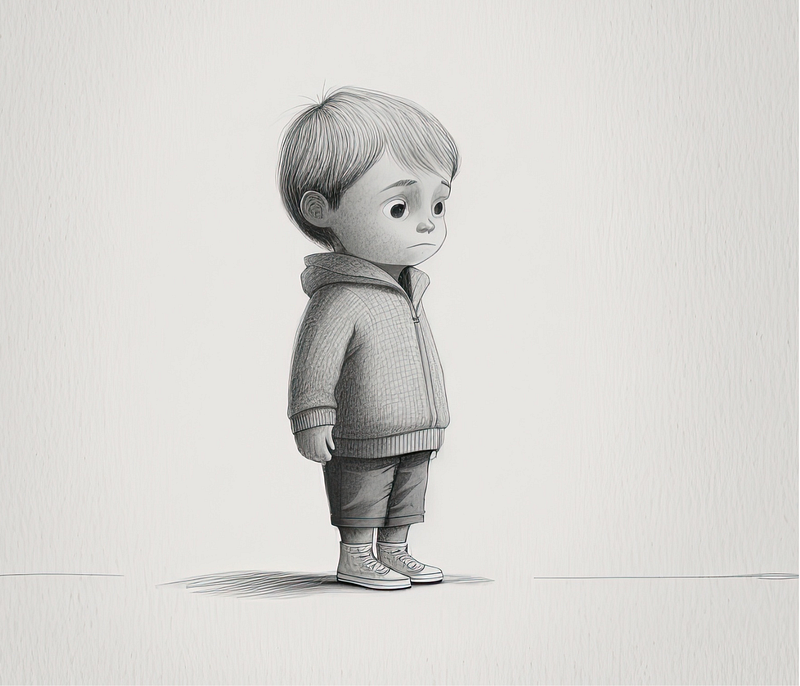
Figures to Shulevitz are the literal characters on the page, whatever type of lifeform they take. And your writing needs at least one character. Who is it? Is it you? If so, who are you? Where are you? Will the reader say, ‘oh yes, there’s you, feeling playful today, a little dandy; this is going to be fun!’ or will they say, ‘What is this?! A lecture, a script, instructions on how to do something I’m not even sure I want to do? Where is the voice? The personality? The beating heart?’
Handle your figures carefully. Use images to help you. Give your reader something for free that doesn’t require them to work for it and that will enable them to quickly connect with the lives in your writing, whatever, wherever and whoever they are. And if nothing else, you need to be there, because figureless writing is, at best, a solitary footprint in the sand. And no one wants to trust in that. Now onto —
line
Demarcation was the outline, so what is the difference, I hear me say, and you too, perhaps? Well, I think line focuses attention inwards, whilst demarcation sends it outwards. Shulevitz asks whether your line is broken, heavy, light, soft, descriptive, sketchy, bold or hesitant? Does it define geometric shapes, is it mannered?
Ask these questions of your words and what you are doing with them, specifically with your choice and use of imagery.
Are you boldly brandishing images like fire from a brazier, or are you hesitantly framing a description with ‘seems’ and ‘as thoughs’, leaving a formless melted popsicle instead of substance? Is your image choice second-hand, old-hat, so common as to make the reader want to put a bucket on their head and bang it?
Or can you open the door to those caged-in thoughts and let them fly all over the place? Can you stand back for a moment and just observe where they land? Your words may seem to fly with a broken wing, but rest here. What is it like, that broken wing? Because here is a figure. It is you, your words, your desire to fly. Your desire to be spontaneous. But you want to be good. Oh, so good.
SO START THERE
But don’t travail too much over it so that it becomes affected and doesn’t want to leave the cage; just put some scraps on your palm, and wait. Look away awhile. Let yourself be effaced and your writing will find a life of its own.
A watched kettle never boils, and a closed hand never writes.
In the Great, Green Room
by Jacqueline Day
But where did all the colors go?
In the great green room
There was a telephone
And a red balloon
— Goodnight Moon, Margaret Wise Brown
My son always tells me that all writers are depressed. I’m not depressed, I say. But I can’t change his statistics. Maybe if there was more color in words this fog would lift for wordsmiths — who wants to forge only monochrome words under their hammer?
Before we could read, we had the colors of everything poured into us as a heady concoction of the world’s breast milk. Creamy white. Brown mouse. Red berry. Blue car driving off under orange sun.
But somewhere between blocks in primary colors, naming our teddies ‘Brown Bear’ or ‘Blue Bear’ and choosing lipstick in Taupe and Nude, did someone warn us that mentioning color was uncool or bad etiquette, like asking how much something cost, or saying someone else cleans your loos?
Passing with flying colors
Colored pencils were my happy child place: the names read like the start of fairy tales — Ultramarine; Delft Blue; Scarlet Red.
Sharpening was bitter-sweet as the curls of wood were tinged with wasted color, and they would sit in small piles on the floor between my knees, bonfires ready for tiny folk to kindle with fire dust from Middle Purple Pink moth wings.
When the pencils were lined up, ready for battle, I would call their names one by one, a regiment of hues.
I don’t recall much coloring, except for puff-sleeved, heart-neckline dresses copied from the starlets of black and white films, so I had to imagine whether they were carnation pink, mallard duck green or a desperate berry juice blush.
It was the names and the ordering that wooed me. The niceties of nomenclature. The exotic turn of phrase to describe what I saw as cream, or green, or grey as some other conjecture of syllable and allusion. Allusion to a world that ran like ink beyond the walls of my bedroom, my floor a magic carpet the colour of mulberries.
Radiant, rainbow pencils that made me love words, not anything on paper. But now that I am old enough to write color in words, I find that it has gone out of fashion. If it has ever been in, that is.
Sailing under false colours

Whilst tutoring a student, I suggested steel, gunmetal, platinum, pewter and chrome as colour words to use in the creative writing part of their exam. We can always find metal, I said, and there is a confidence in describing grey in these terms that whispers, ‘writer’.
Charles Darwin went a step further when he travelled on the H.M.S. Beagle; he took the German mineralogist, Abraham Gottlob Werner’s Nomenclature of Colour (1814) used by naturalists, scientists and artists. Aurora Red. Arterial Blood Red. Vermillion Red.
I bleed for this book and the knowledge of life that it references in painted palettes and notes, and the words remind me of a list I was given at a wine tasting.
I can’t wait to say, ‘sweaty saddle’, I told the vine specialist, refusing to describe the wine as earthy or fruity again. This smells like woodlouse, I suggested, making up my own connoisseur vocabulary.
Wine has the language of aroma, but today, I just want more pearly turquoise in my life, bleached pink of a mole’s nose and astringent green, like mouthwash.
Darwin’s bunkmate book had details to describe every shade of every plant, animal and mineral, so we have no excuse not to use color in our writing. Brownish Orange, for example, is the color of dark Brazilian topaz, the eyes of the largest flesh fly and the stigma of the orange lily.
We can use the colors of things as simile and metaphor; orange lily trousers; clouds the shade of flesh flies.
Or, the color of urine, on a hot day aboard the Beagle (context to follow).
Nailing your colors to the mast
Take the book, article or magazine closest to you and read it on a random page. Is there a color mentioned?
I have an unread Never Mind by Edward St Aubynn (1992), page 151: ‘Urine-coloured light’; ‘dark-yellow lampshades’; ‘black cabinet’.
Then a University annotated copy of Cold Mountain by Charles Frazier (1997), page 129: ‘tiny black seeds’. A page heavy with description, but just one color that technically isn’t a color, but the absence of light.
Poetry? I’m randomly opening to ‘The Dream’ by Theodore Roethke (1958): ‘white seafoam’. That’s it. Lots of nouns, and only one color that again, isn’t really a color, but the want of it.
Maybe we need to ‘go deeper’. An essay on thick pages called ‘Treacle and Lamp-Posts’ from 1882. On the third page: ‘pale pink blotches’, ‘large black eyes’ and a ‘dark-reddish brown colour’. No, not dismemberment in a horror piece, this is naturalism, and frankly, I expected more vibrancy. (Although with that evocative title, I can almost forgive anything.)
The ‘urine-coloured light’ excites me the most from the frail offering above, but equally, I hate it. What has happened to my army of colors? Who defeated them when we left childhood?
Showing their true colors
Flax-flower blue. Leek green. Straw yellow, the color of polar bears. These words of Werner offer a fulness to me with all the delicious promise of a menu. Plum purple. Clove brown. Pistachio green.
If you write, feed people and write in color. Fill in the blanks with Shrubby Pimpernel. Doodle your borders with Saxon Topaz.
But, and oh, little buts the color of crimson sealing wax, as I try to form the right words for colors, for lavender’s lavender, or rose’s rose, I see what the problem is. We are made for color, from color, but even with Werner’s guide, we don’t have the words for it all. Not yet.
We must name colors by comparison and urine-yellow may be all we can muster today. And that’s OK. Sometimes we must bow low to lift up what is wordless.
Fiction Starts With Fact
by Jacqueline Day
How to easily write your way into a story
But in the end, stories are about one person saying to another: This is the way it feels to me. Can you understand what I’m saying? Does it feel this way to you?
― Kazuo Ishiguro
If I stood in front of you right now and said, Please tell me a story, how would you feel? And if you wanted to be good-natured, despite feeling awkward, where would you start?
When I first said that to one student I tutored, as I closed the book of Noodlehead Stories we had been reading, he looked at me with that look — that, You are really giving me permission? look, then he stood up and paced the room, a cliché of delightful action.
His story had started before I finished saying ‘story’. Even the school bell sounding twice and me packing up my papers wouldn’t stop him. He had literally walked right into a story and he found it was a place where he could finally be himself, yet not mention himself at all.
But something comes along between middle school and adulthood and even when we want to tell a story, it seems as though someone has just said, Climb this rockface. No pressure, just get to the top, and don’t pause; don’t make contorted faces; and don’t inhale air. Just climb. And by the way, in case you wondered — everyone falls.
Top-and-tail your stories
Writers don’t need tricks or gimmicks or even necessarily need to be the smartest fellows on the block. At the risk of appearing foolish, a writer sometimes needs to be able to just stand and gape at this or that thing – a sunset or an old shoe – in absolute and simple amazement.
― Raymond Carver, Fires: Essays, Poems, Stories
Fact and fiction share a room in a child’s life. They top-and-tail in bed and stay up late, giggling under the covers and shining the torch in each other’s face. Sometimes they argue, but mostly, they just want to be together when it is too dark to stay on the swing, and too early to overfill cereal bowls with Coco Pops.
If one gets kicked out the bed for a bad smell, or just being, the other quickly feels lonely and a small hand shoots out to welcome them back into the blanket bunker, no questions asked. No apologies expected.
So what if you call yourself a writer, but the potential stories stare down at you from a high shelf and you can’t find a stool to even read the spines? Sharing a bed with anything resembling fiction is, well, likely to remain a fiction and the crocodiles of sleepless, storyless nights (and days) are snapping at your heels.
Beginning advice
Start with what you know, but this doesn’t mean what you think it does: it shouldn’t be ‘your lived experience’, which can get knotty as we try to work out how deep we need to have gone to qualify, but just something you know as a standalone fact. Books can be fuel. Fishermen throw a net over the side of a boat. You can hide money in a teapot.
Any of the above can lead you into the idea of a happening, a moment, or a character; not because you have been creative, but because you have found a brick and put it down. And once it is down, you can either stand on that brick and reach 5 inches higher to see the start of a story, or you can find another brick and see if that takes you high enough.
And unless you are building to an architectural drawing, or a builder’s draft (for writers, this is the work of an outline), you don’t need to prepare all your bricks before you start.
You actually don’t need more than one because today is an other-worldly day: the clocks have stopped, you have slipped between their hands into that waiting place where all things begin, and there is only room for you and one brick (that’s a rule) and you wouldn’t want to go breaking any rules just yet, would you?
Putting it another way
Don’t loaf and invite inspiration; light out after it with a club.
― Jack London
If you look at all the novels or short stories already written and it feels like your skin is going to melt off your face before you produce anything creative, you are walking round the idea of fiction as though it were a campfire.
Everyone else has an instrument, or can sing, but you have nothing to contribute. You want to be part of the blaze of human ideas and imagination that outlives death. But you don’t even have a stick to throw on the fire.
We can believe many lies when we want to write, but that latter thought is the biggest lie of all. You have something in your hand, we all do. You have a fact; in fact, many thousands of facts.
I have just taken out my earrings and I could use the fact that you can remove earrings to find my way into a story (and for these examples, I haven’t laboured, I have just written what followed on from the fact in my mind):
She removed an earing and placed it on her open book. Then the other one. She didn’t know I was looking, but I had been watching her since she arrived in the library. I hadn’t noticed her earrings; now I couldn’t take my eyes off them.
Or I could just pull up a random fact from my memory— anything will do. Cosmos grow wild in South Africa and you get fields of them. In England, we plant them carefully, seed by seed and they don’t come back the year after:
The cosmos that grew wild in the field behind the house had started to creep into the corners of everything. Put some in a vase, her neighbour had said, as she leaned over the fence. But Emily was thinking about weedkiller. She didn’t want their pink and white faces sitting at her table where family should have been.
It really can be anything, and you just need to start with a fact, then see what fills out around it once you have put it on the page: build around the fact, feel your way around the fact, but don’t try and start it all with fiction.
And this is important, too — you need to see that brick once it is on the page, not as words, or even as fact, but as a launch pad. More poetically, as a promise: a promise of a story.
You’ll find it. There is always a story. And that’s another story.
The Taste of Books
by Jacqueline Day
And why teens can’t stomach them
The more I tutor teenagers, the more I realize that words have become entropically dissociated from books. Yes, they may have a class copy of the odd novel; they may be asked to buy it and have their own, but it is a book so measured and sifted and overworked in class that it becomes a millstone round their necks rather than a treasure.
Novels have become a vacuous, lacklustre pain in the neck, juiceless and lifeless and lacking. Writing has been reduced to a flatness because it has been removed from its covers too many times for these young people and placed on sheets of virtuously compostable, yet throwaway paper. Throwaway meaning. Again and again words are just dumpable things. And the kids are all to ready to do the dumping.
Reading of novels is often via itty bitty segments on worksheets or extracts on the board, so teens don’t see the need to refer back to the whole, ever, even if it has been read through in class at one point: now a washed-out memory fading on the horizon line; the book is a dissected orange, dried up and shrivelled in segments.
Yet walk into any bookstore and the walls of freshly-minted novels shows that, no, the novel isn’t dead. Fabulous cover after fabulous cover means that anyone who loves books is in a sweetshop for the mind, pulling out novella, chunky novel, obtuse collected poems, flash fiction collection…trying to remember where to return these intoxicating goodies in case the doll’s house of alphabetized cards collapses around them, and everyone points and stares, eyes peeping out from their own carefully chosen bag of sweets.
For teens today, though, they often leave their English class hating books. Because for them, books are at the back of these infernal sheets of paper and extracts and quotes so books are the author of the confusion of figurative language, structural devices and authorial intent. Books (whether fragments of books or overdone whole books) are tragically to blame for the disgust and irrelevance of books in the young adult mind.
But if this is true, why is that when I place a book on the desk in front of the student who never reads (who hates English and books and for whom the two are just one big dollop of goo they think they’ll never be extricated from), they are intrigued; when we open the book, even to hunt down a dry semi-colon or two, or to read a passage in-situ to show something, anything, why do I feel them hungrily waiting for me to carry on reading?
One student who refused to even touch a book initially, when we had just five minutes left one day, asked if I ‘happened’ to have that book that I’d read to him a couple of weeks ago. The one they had followed with their eyes but insisted wasn’t funny. Not funny at all, they said, shaking their head.
Another new student started our sessions by saying that he, too, didn’t really read, and he, too, hated English, but yes, he would like to borrow the book I had brought with the picture of a semi-submerged submarine and an explosion behind it. Yes, he said, I must read more. This is all about giving books the physical space they need on the table where chances are, devices and time and age have already crowded books off the table at home.
Physical space matters because books have become weirdly disembodied by the education system. Classrooms used to be bookrooms, but books have been replaced by laptops, or nothing, and the cost of supplying new books for a whole class is, well, ludicrous to those doing the budgeting, so the ‘same old, same old’ is hauled out the dank corner cupboard year after motheaten year. No sweetie-shop haul in most schools I know.
But, ironically, give a teen an interesting and well-loved book, and he will ask for another book. Let a teen see you pick up a book with love and enjoy flicking through the pages, hunting and searching and entering its world, and they will start to feel that secret place rumble; that part of humans that desires story and revelation and alternate realities, with words that cease to be words as they shed their clothes and become food.
PHOTOGRAPHY | ART | CULTURE
Appreciating Photography as an Amateur
by Jacqueline Day
And missing the slower days of film cameras
On a recent trip to the Tate Modern, London, to see the new exhibition, ‘Expressionists, Kandinsky, Munter and the Blue Rider’, and being very disappointed with the loose, almost unrecognisable paintings of Kandinsky (and finding nothing new from Franz Marc), I rushed into the arms of a photography curation instead.
I’m a photography outsider, despite having spent years on high-zoom or angling my non-state-of-the-art semi-manual through portholes, down tunnels or up among the pigeons. Then digital arrived and everything flattened and I didn’t need to plan, just press.
I didn’t have to think about the cost of ordering the photographs, or that I only had 3 photos left to take on the Kodak film, so I better make them count. And the light seemed to come in all at once and I gave up on hard zooms or architectural angles. Black-and-white lost its nuance.
My photographic world went the way of the rest of the world — disposable. The easier things get, the more they lose their fun. (I think I should tell my teenage daughter that, too. Just in case.)
I agree with British artist and director, Derek Jarman, who says in his beautifully written book, Chroma (Vintage, 1994):
There are many colours now, but only four colours were used by great Greek painters. Everything was superior when there were fewer resources.
I miss those days of frugality and fewer resources that made each picture important and a guaranteed hard copy delivered by the postman. Peeling back the seal on the pack of holiday photos that arrived 3 weeks after the holiday was part of the holiday. Now it is more likely we book our next holiday whilst on holiday than take artsy photos of the current one.
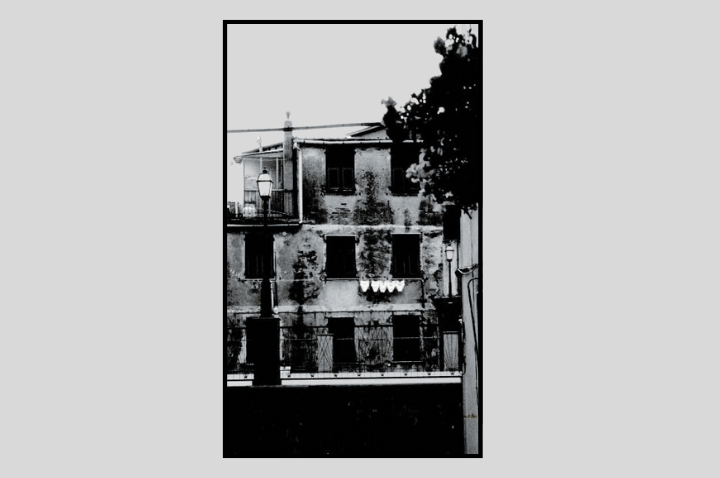
But back to the gallery.
Absorbing the zeitgeist
As a self-conscious photography outsider, when in a gallery, whether in Lucca or London, I would assume this must be good to be there.
I exhibited typical outsider behaviour, leaning in too quickly to read the curator’s comments on the wall, or maybe, if commentary isn’t her thing any more than art theory, looking at the person next to her and mirroring their ‘humphs’ and wide-legged, cross-arm stance. Their way of looking.
Is this photograph just one on the pathway to hardcore art, only meant to receive an understanding, cursory nod? Or maybe it is badly curated and needs to be returned to later when we’ve absorbed the zeitgeist?
I would wonder, who let me in here, photography-ignoramus that I am? All along I should just have stayed home with a cookie.
This is the infernal existential backspin of viewing photographic art when you aren’t steeped in its theory. But that day at the Tate, as I had just chanced on the photographs, I dotted between them irreverently. I ignored the ones I didn’t like and lingered on those I did.
Luminous bodies
I didn’t like the staged photographs of underwear-clad black women in dingy rooms, but the ones that seemed like holiday snaps mattered. They were far from snaps, rather bohemian ‘flâneur’ style ones by Joel Meyerowitz (although probably not taken whilst wandering aimlessly) and shot on his 35mm camera.
The display had photographs of almost the same scene in colour next to a black-and-white version. I rushed the colour to look at the monochrome.
Black-and-white does as it says on the tin: it puts things into relief and makes them one thing or the other. Black-and-white clarifies because it simplifies.
But when I look around a gallery, I want stories, too; ambiguous ones; odd ones; ones that eviscerate the description and tell me a secret. If a smudgy, foggy Kandinsky doesn’t step up to the table, a black-and-white photo often does.
…a luminous body will appear more brilliant in proportion as it is surrounded by deep shadow…
— Leonard da Vinci, Notebooks
I look for the luminous figure and the tale they’ll tell, and although Meyerowitz called his exhibition A Question of Colour, there was no question which version captured the luminosity for me. Outside a gallery, I am drawn to side streets in deep shadow if I am ‘flâneusing’, not because I am drawn to the dark, but the light, and I see the light more clearly from the shadows.
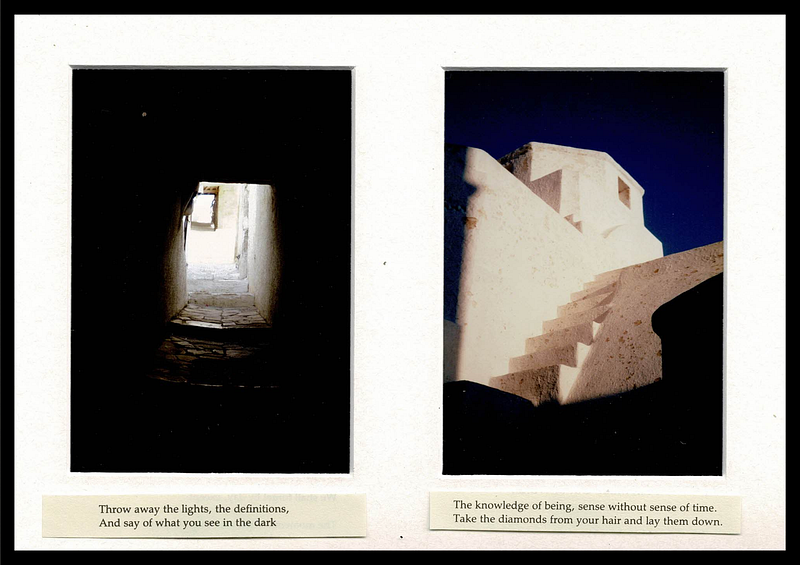
There is, after all, a time for color, and a time for its absence. To quote the scrap of a poem I fixed to two framed photographs, student-style, in my days with the film camera:
Throw away the lights, the definitions
And say of what you see in the dark
— ‘The Man With the Blue Guitar’, Wallace Stevens
I may be a photography amateur, but I’m not ashamed anymore, and next time I visit the Tate, I’ll head straight for what I know I like.